MuSiC = Vibe & Resonance Harmonics = Second Matrix = Localisation [R.A.M's KT95]
NarCiSsism = Fear ByProduct = founding element of the Capitalism = Persona
Fugue, a form of musical writing, born in the XVIIth century, called "fuga" (from Latin: fugere, "to flee")
Wolfgang Amadeus Mozart's Clarinet Concerto in A major, K. 622 written in October 1791 for the clarinettist Anton Stadler. The second movement (Adagio), which is in rounded binary form (i.e. ABA'), is in D major. It opens with the soloist playing the movement's primary theme with orchestral repetition.
Our senses enable us to perceive only a minute portion of the outside world. Our hearing extends to a small distance. Our sight is impeded by intervening bodies and shadows. To know each other we must reach beyond the sphere of our sense perceptions.
— Nikola Tesla
Yggdrasill
The poems of the platform sutra.
《六祖大師法寶壇經》,六祖壇經 Liùzǔ Tánjīng: Platform Sutra of the Sixth Patriarch
神秀偈
身是菩提樹,心如明鏡臺。時時勤拂拭,勿使惹塵埃。
惠能偈
菩提本無樹,明鏡亦非臺。本來無一物,何處惹塵埃。
惠能偈(其他版本)
菩提本無樹,明鏡亦無臺。佛性常清淨,何處有塵埃。
心是菩提樹,身為明鏡臺。明鏡本清淨,何處染塵埃。
菩提本無樹,明鏡亦非台。本來無一物,何假拂塵埃
Shenxiu wrote on the wall:
Our body is a bodhi tree
the mind is like a propped-up mirror
always keep it polished
don’t let it gather dust
Upon reading it, the Fifth Patriarch said,
This poem of yours shows your understanding has reached the threshold but has not yet entered the door. If an ordinary person uses your poem in their practice, they won’t regress. But someone who seeks perfect enlightenment will never realize it by means of such an understanding. If you want to enter the door, you have to see your nature. Go back and think about this for a few days and write me another poem. If you can enter the door and see your nature, I will give you the robe and the Dharma.
惠能 Huineng felt compelled to respond with his own poem:
Bodhi isn’t some kind of tree
this mirror doesn’t have a stand
our buddha nature is forever clear
where do you get this dust?
The mind is the bodhi tree
the body is the mirror’s stand
the mirror itself is so clear
dust has no place to land
Upon reading it the Fifth Patriarch gave 惠能 Huineng Dharma transmission.
惠能 Huineng said
Good friends! The prajna wisdom of enlightenment is something everyone already possesses. But because your minds are deluded, you can’t understand by yourselves. You need to find a truly good friend to show you how to see your nature. Good friends, this buddha nature isn’t different for the ignorant or the wise. It just depends whether people are deluded or awake. When people are deluded, they’re ignorant. When they’re awake, they’re wise.
Addiss, Lombardo, and Roitman give a different translation:
The body is the tree of enlightenment,
The mind is like a bright mirror’s stand;
Time after time polish it diligently,
So that no dust can collect.
Addiss, Lombardo, and Roitman give the following translation:
Enlightenment is not a tree,
The bright mirror has no stand;
Originally there is not one thing-
What place could there be for dust?
According to McRae, "the earliest version of the Platform Sutra contains two versions of Huineng's verse. The later version contains one version of Huineng's stanza, somewhat different from the two older ones:
Bodhi originally has no tree.
The mirror has no stand.
The Buddha-nature is always clear and pure.
Where is there room for dust?
The mind is the bodhi tree.
The body is the bright mirror's stand.
The bright mirror is originally clear and pure.
Where could there be any dust?
Bodhi originally has no tree.
The bright mirror also has no stand.
Fundamentally there is not a single thing.
Where could dust arise?
Thursday, November 11, 2021
The oldest source for the coin method
During the last meeting of the Dutch Yijing group there was confusion about the assignment of the numbers 2 (yin) and 3 (yang) to the sides of Chinese coins. Old Chinese coins have four Chinese characters on one side and the other side is blank or has two Mongolian characters. When I looked for Chinese sources on this I found that there isn’t much agreement on the designation of the numbers, one of my books says that the side with Chinese characters is yang (see picture), and in this lecture Moxiang Liao 廖墨香 seems to follow the same designation, but there are websites that say otherwise. Curious about the origin of the coin method and wanting to know how the Chinese people in the early times did it I did some digging.
Bent Nielsen says in his book Yi jing Numerology and Cosmology:
Nielsen says that the earliest reference to the coin method is to be found in the commentary of Jia Gongyan 賈公彥 (who lived around 650) to the Yili 儀禮 (儀禮疏). Wanting to know how Jia referred to it I looked in my digital version of the Yili, which incorporates the commentary of Jia Gongyan. I found the following passage:
In this passage Jia uses the words shao 少, ‘few’ and duo 多, ‘much’ to name the two sides of a coin, but it isn’t clear what is what: is shao the side with the four Chinese characters or is it the other way around? My dictionaries don’t say anything about this either. But when I looked for the word danqian 單錢, which appears in Jia’s passage, the Hanyu Da Cidian 漢語大詞典 dictionary was helpful:
古代錢筮法術語。謂擲三錢 而成二面一背,象徵少陽之爻。 Technical term from a coin divination method from antiquity. When you throw three coins and you receive two mian 面 and one bei 背 it is called like this. This symbolises a young yang-line.
‘Two mian 面 and one bei 背’. What is mian and what is bei? In this case the dictionaries also assume that this is common knowledge. The Hanyu Da Cidian says that bei is the reverse side of a coin (錢幣反面的專稱), well, that doesn’t help much. Fortunately Jack Chiu helps me out with his book The Secret of Wen-Wang Gua. He says:
Chinese people used to call the side with Chinese characters the Face or Mian 面, and the other side the Back or Bei 背.
(p. 82)
Concluding: the side with four Chinese characters (mian 面) is called duo 多 (probably because this side has ‘many’ Chinese characters?), and the other side (bei 背) is called shao 少 (because this side has no or few Chinese characters). Knowing this we can translate the passage by Jia Gongyan as follows:
Today coins are used. With 3 shao (= the blank side or with two Mongolian characters) one has chongqian, this is 9. With 3 duo (= the side with four Chinese characters) one has jiaoqian, this is 6. Two duo and one shao is danqian, this is 7. Two shao and one duo is chaiqian, this is 8.
If Nielsen is right, and the sources are correct, then this would be the oldest reference to the coin method.
π
@Black's blacker
玄之又玄,
衆妙之門。
π Râ Med⟹π ☉ 🌋
π Né Al⟹π ∏*𐎛𐎍
π Tui Ta Ry⟹π 兌 塔☉
* ∏ N-Ary Product 「生」
玄之又玄,衆妙之門。
樂ㄌㄜˋ《ㄩㄝˋ》Le•G•Ion 〘䷝「離、三十」〙
Friday, November 12, 2021
"Delight in the law of the Divine.
Meditate the same day & night.
And then in all phases of your life,
you will be happy, harmonious, and successful
in every phase of your relationships."
ECRL 2062-1
Wednesday, November 10, 2021
Sun Wukong & the Rhesus Macaque
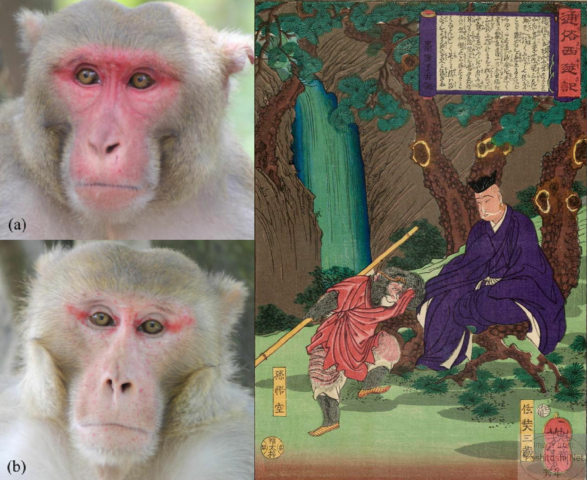
Sun Wukong is based on a real species of monkey? In chapter one, the patriarch Subhuti tells Sun: “Though your features are not the most attractive, you do resemble a pignolia-eating macaque [husun, 猢猻].” [1] The master dismisses the Hu (猢) character for linguistic reasons, and he drops the animal radical (犭) for religious reasons, leaving Sun (孫, “grandson”) as Monkey’s surname. Possibly quoting an earlier source, the noted Ming physician Li Shizhen (1518-1593) explains the meaning of 猢猻husun and associates it with a particular genus: “Since a macaque resembles a Hu-barbarian [胡], he is also calledhu-sun, ‘grandson of a barbarian’” (Gulik, 1967, p. 35). There are several species of macaque native to China, but anthropologist Frances D. Burton (2005) believes theRhesus macaque(Macaca mulatta) is the best fit:
Monkey goes bare-headed and wears a red dress, with a yellow sash, and black shoes. This is a fitting description of M. mulatta, whose reddish fur on shoulders and back yields to lighter, more yellowish fur on the abdomen, and whose feet and hands are black. The ‘pouch’ to which the Monkey King himself refers [to in the novel] would likely be the cheek-pouches common in macaques, but not gibbons or leaf-eating monkeys.
[…]
One of Monkey King’s epithets is ‘Fiery Eyes”. His red eyes–a characteristic he shares with the actual red-rimmed eyes of M. mulatta [Fig.1][…]–resulted from his punishment in a crucible. […] He is also a ‘red-bottomed horse ape’, which suggests M. thibetana or, again M. mulatta, both of which are large animals, with pronounced redness on the bottom, especially during reproductive phases (p. 148).
Fig. 1- A comparison of Rhesus macaques with red-rimmed eyes during mating season (top left) and other times (bottom left) (larger version). Fig. 2 – An 1865 piece by Yoshitoshi (larger version).
In chapter two, a monster describes Monkey as being “not [even] four feet tall” (Wu & Yu, 2012, p. 128). Rhesus males measure on average 1.74 feet (Lang, 2005). But I imagine these measurements were taken while they were in a quadrupedal posture (on all fours), which would make them taller if they stood.
All of this information is important as modern-day depictions of Sun portray him as a man (or the size of a man) or a hulking brute with huge muscles. Such depictions are extremely inaccurate. He is a short monkey, plain and simple. His great strength, martial arts skill, and magical abilities make him a formidable warrior, not his size. The Japanese produced the most accurate renderings of monkeys. The work of Yoshitoshi (1839-1892) is a good example (Fig. 2).
Update: 05-18-17
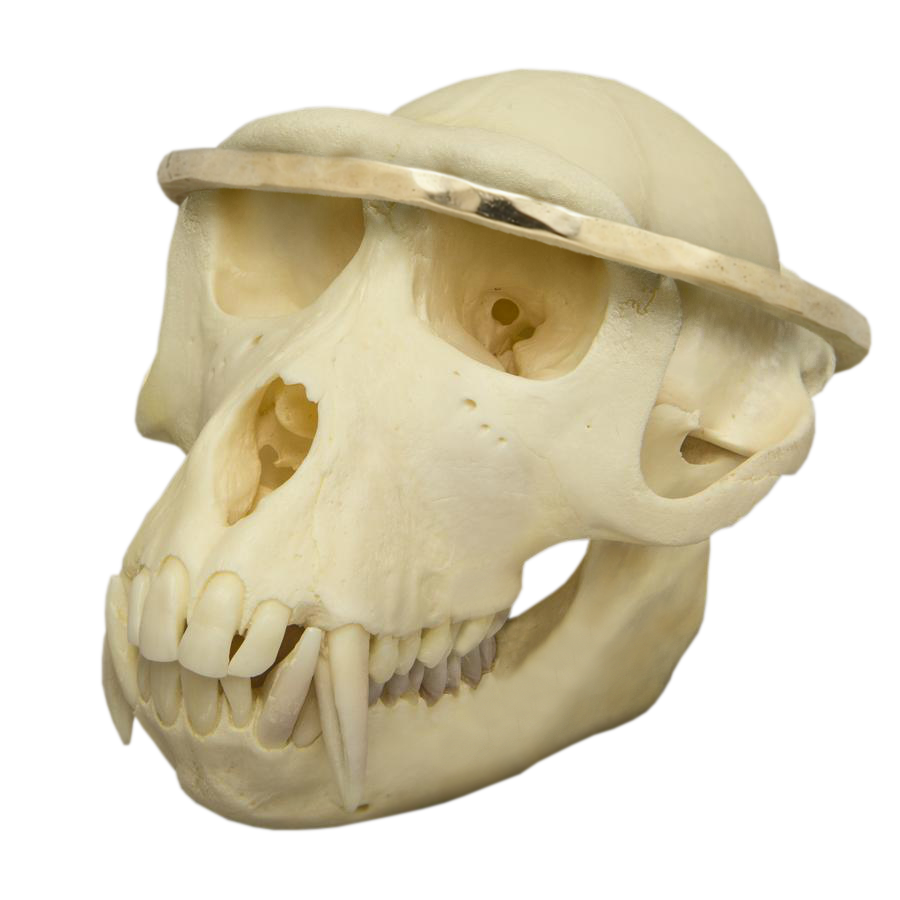
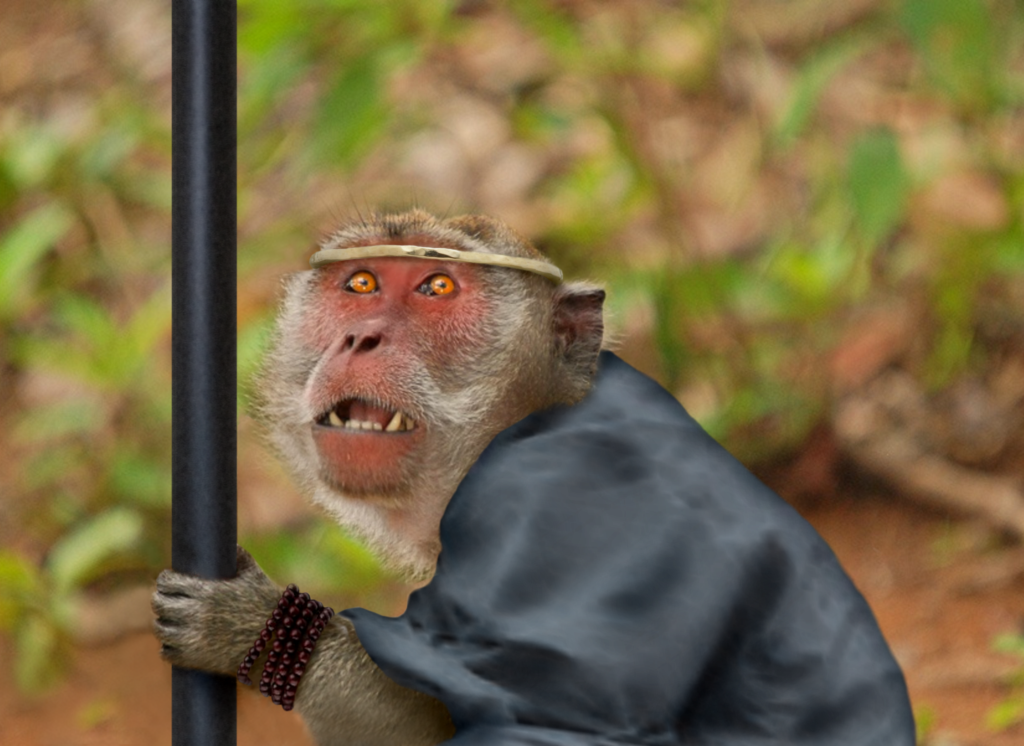
Readers will no doubt recall the golden fillet that Sun Wukong unwillingly wears on his crown. Humanoid depictions of the character show the band sitting on the frontal and parietal areas of the skull. But since Rhesus macaques have a much smaller brainpan, the circlet would have to wrap around the top of the eye orbits and the back of the occipital bone in order to be effective (fig. 1). It would set just above the eyelids (fig. 2).
Fig. 1 – A Rhesus Macaque skull adorned with the golden fillet (larger version). Fig. 2 – A modern depiction of Sun Wukong wearing the circlet (larger version). Photomanipulations by the author.
Notes: 1) Source altered slightly. The original quote states, “…you do resemble a pignolia-eating monkey (husun)” (Wu & Yu, 2012, p. 115). Sources: Burton, F. D. (2005). Monkey King in China: Basis for a Conservation Policy? In A. Fuentes & L. D. Wolfe (Eds.), Primates Face to Face: Conservation Implications of Human-Nonhuman Primate Interconnections (pp. 137-162). Cambridge: Cambridge University Press. Gulik, R. H. (1967). The Gibbon in China: An Essay in Chinese Animal Lore. Leiden: E.J. Brill. Lang, K. C. (2005). Rhesus macaque Macaca mulatta. Retrieved from http://pin.primate.wisc.edu/factsheets/entry/rhesus_macaque Wu, C., & Yu, A. C. (2012). The Journey to the West: Volume 1. Chicago, Illinois: University of Chicago Press.
The Bull Demon King (Niu mo wang, 牛魔王) is also known as the "Great Sage Parallel with Heaven" (Pingtian dasheng, 平天大聖). This plays off of Monkey's title the "Great Sage Equaling Heaven". Princess Iron Fan (Tie shan gong zhu, 鐵扇公主) is also known as "Rakshasi" (Luocha nu, 羅剎女). And their son Red Boy (Hong hai'er, 紅孩兒) has two other names, "Great King Holy Infant" (Shengying dawang, 聖嬰大王) and "Sudhana" (Shancai, 善財). The latter is a Buddhist name given to him by the bodhisattva Guanyin when he becomes her disciple. This is based on a famous acolyte from Buddhist literature.
It should be remembered that the names of animal spirits generally describe what they look like. Sun Wukong is simply his religious name (note 11-10-21: a reader reminded me that his surname Sun is also based on his monkey appearance). He was first called the "Stone Monkey" (Shi hou, 石猴), and he later took "Handsome Monkey King" (Mei hou wang, 美猴王) as his name. Even Zhu Bajie's personal name Zhu Ganglie (豬剛鬣, lit: "Stiff Bristles Pig") refers to his appearance.
Tuesday, November 9, 2021
Astronomers Found a 'Tsunami' of Gravitational Waves & Their Origin
Cosmic winds are about to blow us all away (figuratively speaking, of course). Astronomers have pulled in the biggest haul of black hole events: The last series of gravitational waves observed were the largest collection yet, with a colossal 35 gravitational wave events monitored in five months, between November 2019 to March 2020, using the LIGO-Virgo interferometers.
The biggest haul. Taking the average, this means nearly 1.7 gravitational wave events were identified, per week. And it's a sharp jump in frequency from the 1.5-event weekly average identified during the previous run, ballooning the total number of events detected since the first one in September 2015, to 90.
A fatal cosmic dance. Thirty-two of the 35 additional detections were likely created from mergers of black hole pairs, which happens when two black holes move into a close enough orbit for their mutual forces of gravity to pull them into one another. The collision is violent, sending blinding light far beyond the visible spectrum outward, and twisting the very fabric of spacetime into colossal waves that can span unimaginable distances. Afterwards, only a singular, gigantic black hole remains the sum of the earlier two. And the gravitational waves continue outward like ripples in a pond, all the way to Earth, where astronomers can monitor the event, and analyze the properties of the now-merged black holes.
On a collision course. The recent series of black holes monitored spanned a wide range of black hole masses, the most massive of which was roughly 87 times the sun's. This one merged with another that was 61 times the sun's mass, and the new one that formed from the collision was 141 times the sun's mass. In another case, a different merger event created a black hole 104 times the sun's mass.
Both of these cases fall into the class of intermediate black holes, which includes those with a mass from 100 to one million times the sun's mass. Few black holes have been detected of this size.
This series of observations is endlessly fascinating, and there's much more to explore in the preprint study. But as gravitational wave detectors continue to study the death and mergers of black holes, we learn more about how the most violent and mysterious forces in the universe come into being.
道德經第七十七章
天之道,其猶張弓與?
高者抑之,下者舉之;有餘者損之,不足者補之。
天之道,損有餘而補不足。
人之道,則不然,損不足以奉有餘。
孰能有餘以奉天下,唯有道者。
是以聖人為而不恃,功成而不處,其不欲見賢。
Dao De jing Chapter Seventy-seven
77 — Alan B. Taplow — 77
EQUILIBRIUM
As a bow is bent, so bends the way of nature.
That at the top,
Bent downward toward the centre.
That at the bottom,
Bent upward toward the centre.
The string —
If too long, is shortened,
If too short, is lengthened.
The Tao of nature strives for equilibrium.
That which is abundant is reduced.
That which is deficient is supplemented.
Mankind, on the other hand, will often -
Further reduce what is deficient,
Supplement that which is abundant.
The Sage alone —
Having abundance, offers it to the world.
Works quietly without arousing attention.
Acts without claiming recognition or reward.
Has no desire to reveal his superiority.
Dao De jing Chapter Seventy-seven
77 — Arthur Waley — 77
Heaven's way is like the bending of a bow.
When a bow is bent the top comes down and the bottom-end comes up.
So too does Heaven take away from those who have too much,
And give to those that have not enough.
But if it is Heaven's way to take from those who have too much
And give to those who have not enough, this is far from being man's way.
He takes away from those that have not enough in order
To make an offering to those who already have too much.
One there is and one only, so rich that he the possessor of Tao.
(If, then, the Sage “though he controls does not lean,
And when he has achieved his aim does not linger”,
It is because he does not wish to reveal himself as better than others.)
The Listener, James Christensen, 2006
Dao De jing Chapter Seventy-seven
77 — James Legge — 77
(The way of heaven)
May not the Way (or Dao) of Heaven be compared to the (method of) bending a bow? The (part of the bow) which was high is brought low, and what was low is raised up. (So Heaven) diminishes where there is superabundance and supplements where there is a deficiency.
It is the Way of Heaven to diminish superabundance and to supplement deficiency. It is not so with the way of man. He takes away from those who have not enough to add to his own superabundance.
Who can take his own superabundance and therewith serve all under heaven? Only he who is in possession of the Dao!
Therefore the (ruling) sage acts without claiming the results as his; he achieves his merit and does not rest (arrogantly) in it: - he does not wish to display his superiority.