Wikipedia

Search results

Thursday, July 29, 2021

Cluster & Multitude

"On me Pense donc Je Suis"

Thursday, July 29

"While each soul, each person may have the right to their own opinion and their own activity, they should not only say so but act in such a way; knowing that each soul is destined to return to the Source." 

(ECRL 987-2)

  • せんせい • (-sensei) 
  • 先生: title used after the name of teachers, doctors, lawyers, or certain other professionals
  • 師傅 ㄕ ˙ㄈㄨ, ㄕ ㄈㄨˋ
  • श्री • (śrī) from Proto-Indo-Iranian *ćriHrás. Compare Avestan‎ (srīra). Related to Sanskrit श्रील* (śrīlá)
  1. light, lustre, radiance, splendour, glory, beauty, grace, loveliness
  2. prosperity, welfare, good fortune, success, auspiciousness, wealth, treasure, riches
  3. symbol or insignia of royalty
honorific prefix appended to certain names to mean "sacred" or "holy"
        e.g. श्रीदुर्गा (śrī-durgā), श्रीराम (śrī-rāma)
used as a respectful title (like "Reverend") to the names of eminent persons as well as of celebrated works and sacred objects
        e.g. श्रीजयदेव (śrī-jayadeva)

* Śrīla (श्रील).—a.
1) Rich, wealthy.
2) Fortunate, prosperous.
3) Beautiful.
4) Famous, celebrated.

शांगरी ला Sh[ang]ri-la (गुप्त जगह gupt jagah)
  • Shangri-La, imaginary land depicted in the novel Lost Horizon (1933) by James Hilton
  • Shangri-La, a remote beautiful imaginary place where life approaches perfection : UTOPIA

8/8'88
19880808 (33/42〜VI)
The "August 8 Cluster" (sometimes referred as the "8/8 cluster") is a cluster of eight sensates that were born on the same month and day.

"I’m just like Anne Frank — like Indiana Jones
And them British bad boys the Rolling Stones
I go right to the edge — I go right to the end
I go right where all things lost - are made good again
I sing the songs of experience like William Blake
I have no apologies to make
Everything’s flowin’ all at the same time
I live on the boulevard of crime*
I drive fast cars and I eat fast foods . . . I contain multitudes"

— Bob Dylan, I contain multitudes, Rough and Rowdy Ways (2020)
The title of the song is taken from Section 51 of the poem "Song of Myself" by Walt Whitman, "I am large, I contain multitudes." (Section 51)

« Boulevard du crime » est le surnom donné au XIXème siècle au boulevard du Temple à Paris, sur lequel se trouvaient plusieurs théâtres mélodramatiques dans lesquels étaient fréquemment représentés des faits divers, assassinats et vols. Les Enfants du paradis, film français réalisé par Marcel Carné d'après un scénario de Jacques Prévert, sorti en mars 1945.
Vue générale des théâtres du boulevard du Temple en 1862

Song of Myself, 51 Walt Whitman - 1819-1892 The past and present wilt—I have fill'd them, emptied them. And proceed to fill my next fold of the future. Listener up there! what have you to confide to me? Look in my face while I snuff the sidle of evening, (Talk honestly, no one else hears you, and I stay only a minute longer.) Do I contradict myself? Very well then I contradict myself, (I am large, I contain multitudes.) I concentrate toward them that are nigh, I wait on the door-slab. Who has done his day's work? who will soonest be through with his supper? Who wishes to walk with me? Will you speak before I am gone? will you prove already too late?


Bob Dylan has long been fascinated by the concept of the multiplicity of the self, evident in everything from his fondness for Arthur Rimbaud's phrase "Je est un autre" ("I is another"), which he said caused bells to go off when he first read it in the 1960s, to the lyrics of his Rastafari-influenced 1983 song "I and I". In an interview to promote Time Out of Mind in 1997, Dylan said, "I change during the course of a day. I wake and I'm one person, and when I go to sleep I know for certain I'm somebody else. I don't know who I am most of the time. It doesn't even matter to me".

A paraphrase of this last quote is spoken by Richard Gere's Billy the Kid character via voice-over narration in Todd Haynes' unconventional 2007 biopic I'm Not There (which features the subtitle "Inspired by the music and many lives of Bob Dylan" and takes Dylan's constantly-changing persona explicitly as its subject). Dylan's chameleon-like nature had caused critics to use Walt Whitman's line "I contain multitudes" in relation to him long before he ever wrote a song by that title. Dylan himself quoted the line in an interview for the 2019 documentary Rolling Thunder Revue: A Bob Dylan Story by Martin Scorsese.

Arthur Rimbaud
Lettre à Georges Izambard

Charleville, [13] mai 1871

      Cher Monsieur!

Vous revoilà professeur. On se doit à la Société, m'avez-vous dit; vous faites partie des corps enseignants: vous roulez dans la bonne ornière. – Moi aussi, je suis le principe: je me fais cyniquement entretenir; je déterre d'anciens imbéciles de collège: tout ce que je puis inventer de bête, de sale, de mauvais, en action et en paroles, je le leur livre: on me paie en bocks et en filles. – Stat mater dolorosa, dum pendet filius. – Je me dois à la Société, c'est juste, – et j'ai raison. – Vous aussi, vous avez raison, pour aujourd'hui. Au fond, vous ne voyez en votre principe que poésie subjective: votre obstination à regagner le râtelier universitaire, – pardon! – le prouve. Mais vous finirez toujours comme un satisfait qui n'a rien fait, n'ayant rien voulu faire. Sans compter que votre poésie subjective sera toujours horriblement fadasse. Un jour, j'espère, – bien d'autres espèrent la même chose, – je verrai dans votre principe la poésie objective, – je la verrai plus sincèrement que vous ne le feriez! – Je serai un travailleur: c'est l'idée qui me retient quand les colères folles me poussent vers la bataille de Paris où tant de travailleurs meurent pourtant encore tandis que je vous écris! Travailler maintenant, jamais jamais; je suis en grève.

[989] Maintenant, je m'encrapule le plus possible. Pourquoi? Je veux être poète, et je travaille à me rendre voyant: vous ne comprendrez pas du tout, et je ne saurais presque vous expliquer. Il s'agit d'arriver à l'inconnu par le dérèglement de tous les sens. Les souffrances sont énormes, mais il faut être fort, être né poète, et je me suis reconnu poète. Ce n'est pas du tout ma faute. C'est faux de dire: Je pense. On devrait dire: On me pense. – Pardon du jeu de mots.

Je est un autre. Tant pis pour le bois qui se trouve violon, et nargue aux inconscients qui ergotent sur ce qu'ils ignorent tout à fait!

Vous n'êtes pas enseignant pour moi. Je vous donne ceci: est-ce de la satire, comme vous diriez? Est-ce de la poésie? C'est de la fantaisie, toujours. – Mais, je vous en supplie, ne soulignez ni du crayon, ni trop de la pensée:

                              LE CŒUR SUPPLICIÉ

Mon triste cœur bave à la poupe...
Mon cœur est plein de caporal!
Ils y lancent des jets de soupe,
Mon triste cœur bave à la poupe...
Sous les quolibets de la troupe
Qui lance un rire général,
Mon triste cœur bave à la poupe,
Mon cœur est plein de caporal!

Ithyphalliques et pioupiesques
Leurs insultes l'ont dépravé;
A la vesprée, ils font des fresques
Ithyphalliques et pioupiesques;
O flots abracadabrantesques,
[990] Prenez mon cœur, qu'il soit sauvé:
Ithyphalliques et pioupiesques
Leurs insultes l'ont dépravé!

Quand ils auront tari leurs chiques,
Comment agir, ô cœur volé?
Ce seront des refrains bachiques
Quand ils auront tari leurs chiques!
J'aurai des sursauts stomachiques
Si mon cœur triste est ravalé!
Quand ils auront tari leurs chiques,
Comment agir, ô cœur volé?
Ça ne veut pas rien dire. 

– RÉPONDEZ-MOI: chez M. Deverrière, pour A. R.

Bonjour de cœur,

                                                ARTH. RIMBAUD.

Georges Izambard: Arthur Rimbaud pendant la Commune. Une lettre inédite de lui – le voyant.
In: Revue européenne. 1928, Heft 10, Oktober, S. 985-1015. [PDF]

Hier der Brief (13. Mai 1871): S. 988-990.

Wednesday, July 28, 2021

Ill•usion

There are all sorts of quotes about time. One is by Abhijit Naskar, the author of "Love, God & Neurons: Memoir of a scientist who found himself by getting lost." He wrote, “Time is basically an illusion created by the mind to aid in our sense of temporal presence in the vast ocean of space. Without the neurons to create a virtual perception of the past and the future based on all our experiences, there is no actual existence of the past and the future. All that there is, is the present.”

One of the most influential physicists to have ever lived, Albert Einstein, shared this view, writing, "People like us who believe in physics know that the distinction between past, present, and future is only a stubbornly persistent illusion." In other words, time is an illusion.

It makes sense that time is an arbitrary construct — it's our way of making sense of growing up and growing old while the world changes around us. It is not all that hokey. So let us look at how our perception of time changes in different locations. 

It's All Relative: 

According to Einstein's own theories, time moves differently for someone below sea level than for someone situated on the highest peaks on the planet (according to some studies, "at sea level you age one-billionth of a second less every year than you would if you lived on top of Mt. Everest."). This is due to a phenomenon posited by general relativity called gravitational time dilation.

The logic behind gravitational time dilation is fairly simple: Objects with a lot of mass create a strong gravitational field. This gravitational field noticeably warps the fabric of spacetime around these objects, producing what we know as gravity. When a stream of light particles passes by an object with sufficient gravity, the stream of photons travelling at the speed of light would appear to bend. 

What is even more interesting is that mass can warp the very fabric of time itself, causing it to move slower or faster depending on how massive the object is, and how strong the object's gravitational pull is, which is where time dilation really becomes wonky to us.

It should be noted, however, that an observer in the strong gravity experiences time as running normally. It is only in relation to a reference frame with weaker gravity that time runs slowlier. 

To a person in strong gravity, time appears to pass normally, while a clock in weak gravity runs faster. While to the person in weak gravity, the clock appears to run normally and the clock in strong gravity runs slowlier. There is nothing wrong with the clocks. Time itself is slowing down and speeding up because of the relativistic way in which mass warps space and time.

The faster one moves, the slower time passes in relation to a static observer's perception. Matter travelling at the speed of light does not really experience time or distance, at least relative to a static point. Just watching a spaceship drift off into deep space, the people on Earth view the ship as moving much more slowly through space and time than the people on the ship perceive it to be moving. Crew members would also age at a slower rate, the faster they move.

In the movie "Interstellar" in which time dilation is demonstrated, a crew leaves Earth in search of a habitable planet we humans could flee a dying Earth for. At one point, a few crew members land on a water world located not too far from a gargantuan black hole/wormhole. Given the proximity to the super-dense stellar object, the planet experiences unimaginably volatile waves, and the time dilation becomes extreme. One hour on the surface is equal to 7 years for someone beyond the black hole's orbit. 

Perhaps the strangest example of time dilation can be seen in and around black holes. Time ticks much differently the closer you get to the event horizon of a black hole. Let us imagine two clocks — one held by an observer beyond the immensely strong gravity of the object, and another held by an observer passing near the event horizon — the clock farther away would tick faster than the one close to the event horizon. 

From the point of view of the observer near the event horizon, one day may have passed, while the person observing from the outside may have experienced a decade of time. Eventually, time may appear to stop altogether for the observer near the event horizon.

From the outside, the observer at the event horizon would begin to redshift, which means the wavelength of light they emit would move toward the red portion of the electromagnetic spectrum until the light becomes dimmer and dimmer. Inevitably, time would appear to stop altogether before the observer plunges into the event horizon. In theory, we would never actually see this occur, as the object would appear to freeze and never actually disappear from sight into the black hole.  

Black holes can be formed when a massive star reaches the end of its life, its core begins to collapse in on itself, spitting out large quantities of gas and dust in a supernova event. The star must be at least three times as massive as our Sun in order for this process to occur. It is thought that supermassive black holes, which range from 100,000 to tens of billions of times the mass of the Sun, may be formed by a sort of chain reaction, and this is where extreme time dilation comes in.

What actually happens when something finally gets sucked into the event horizon — the point at which nothing, not even photons (or light itself) can travel faster than the object's escape velocity, thus there's no chance of escaping its grasp — the physics gets rather convoluted and our understanding of how things work begins to fall apart. 

It is believed that observers inside a black hole would eventually stop experiencing time altogether, but they would become stretched out as the black hole slowly ripped them apart — atom by atom. This is called spaghettification, The forces of gravity during a so-called "tidal disruption event" would pull harder on the head vs. the feet, and one would be shredded.

Einstein believed that time is an illusion, that both the future and the past are unchangeable, and will play out exactly the way they were meant to.

Many physicists share this view, but there are some that have alternate explanations for the way things will play out in the long run. One of those suggests that the present, future, and past are still mostly unwritten. Or, they are all playing out at the exact same time. The "Block Universe Theory" contributes a lot to these ideals.

易只 There is only change

"There is no beginning, there is no end,
There is only change.
There is no teacher, there is no student,
There is only remembering.
There is no good, there is no evil,
There is only expression.
There is no union, there is no sharing,
There is only one.
There is no joy, there is no sadness,
There is only love.
There is no greater, there is no lesser, 
There is only balance.
There is no stasis, there is no entropy,
There is only motion.
There is no wakefulness, there is no sleep,
There is only being.
There is no limit, there is no chance,
There is only a plan. "

  Robert Allan Monroe, Ultimate Journey, December 1st, 1994


"I feel it in my fingers, I feel it in my toes
Love is all around me and so the feeling grows
It's written on the wind, it's everywhere I go
So if you really love me, come on and let it show

You know I love you, I always will
My mind's made up by the way that I feel
There's no beginning, there'll be no end
'Cause on my love you can depend"

  The Troggs, Album: Love Is All Around (1967, Writer: Reg Presley)


"And in the end the love you take
Is equal to the love you make"

  "The End" by the Beatles, Paul McCartney (credited to Lennon–McCartney) for the album Abbey Road.


"End? No, the journey doesn’t end here. Death is just another path. One that we all must take."

― J.R.R. Tolkien (The Return of the King (The Lord of the Rings, #3))

छिन्नमस्ता यंत्र Chinnamastā, "She whose head is severed" Yantra
छिन्नमस्ता यंत्र Chinnamastā, one of the महाविद्या Mahavidyas, ten goddesses from the esoteric tradition of तंत्र Tantra, and a ferocious aspect of पार्वती Parvati, the हिंदू Hindu Mother goddess.

Buddhist texts recount the birth of the बौद्ध चिन्नामुंडा Buddhist Chinnamunda. One tale tells of कृष्णाचार्य Krishnacharya's disciples, two महासिद्ध Mahasiddha ("great perfected ones") sisters, मेखला Mekhala and कनखला Kanakhala, who cut their heads, offered them to their guru, and then danced. The goddess वज्रयोगिनी Vajrayogini also appeared in this form and danced with them. Another story recalls how the महासिद्ध Mahasiddha princess लक्ष्मींकर Lakshminkara, cut off her head as a punishment from the king and roamed with it in the city, where citizens extolled her as चिन्नामुंडा-वज्रवरही Chinnamunda-Vajravarahi.

Om Symbol - ॐ is the smallest manŧra (मंत्र).
It is also called mūl-manŧra; mūl (मूल) means fundamental and primordial. Some also call it praṇav-manŧra. 'Praṇav' (प्रणव) means strong/powerful.
A shlok (श्‍लोक) is a Sanskṛiŧ verse, typically of two lines. A manŧra is a phrase (or rarely a word) used for meditation and chanting.
Sacred ancient Indian texts like Veđ (वेद), are collections of shlok/s. Some of these shlok/s are used as manŧra/s.

It is a common practice to begin other manŧra/s with Om, like -
  1. 'Om namaḥ Shivāya' - ॐ नमः शिवाय,
  2. 'Om shānŧi(ħ) shānŧi(ħ)' - ओम शांति: शांति:.

Jainism, Buđđhism and Sikhism originated from India after Hinđūism. These religions adopted some of the Hinđū philosophies and practices. These religions have their own forms and understandings of 'Om'.
Hinduism, Jainism, Buddhism, and Sikhism are together referred to as Đhārmik (धार्मिक, Dharmic) religions. Some followers of Đhārmik religions believe that 'Om' is the ultimate, hyper or super-natural sound!

In देवनागरी ĐevaNāgarī, this word can be written as 'ओम्' or 'ओम'. It is general practice in Hinđī to drop the last 'halant' ('्'). So 'ओम' is generally preferred over 'ओम्'. The spelling 'ओम' is used in literature (mostly as a noun); while the symbol 'ॐ' is used for religious purposes.

The Meaning of Om or Aum

The precise meaning of the word 'Om' is uncertain. It is certainly related to God or Heaven! Twelve verses of Veđ collectively called Māṇdūk`ya Upaniṣhađ (माण्डूक्य उपनिषद) tries to explain this sacred word 'AUm'.
As per the Sanskṛiŧ grammar (Vyākaraṇ; व्याकरण), the vowel 'O' (ओ) is sometimes substituted for two consecutive vowels 'A' (अ) and 'U' (उ); generally, the public too prefer 'Om' instead of 'AUm' (अ-उ-म्)!
Gāyaŧrī Manŧra (गायत्री मंत्र) like many other Veđik shlok/s starts with Om. That is why it might be assumed that Om (ओम) means 'O my (our) Lord' ('हे परमेश्वर').
There is a relation between the words 'Om' and 'Amen'.

The Om symbol - ओंकार

An 'Om symbol' is a sign (glyph, shape) to write (scribe, represent) the 'Om' sound.
'Om symbol' is called 'Oṅkār' (ओंकार=ओङ्कार) or 'Omkār' (ओम्-कार).
The 'Om' sound can be written as 'ओम' in ĐevaNāgarī.
So 'ॐ' is a symbol of the word 'ओम' in ĐevaNāgarī.
People use this sign/symbol for meditation and worship.
Om symbol is drawn mostly as 'ॐ'.

ॐ is the main religious symbol for Hinđū/s and Buđđhists (Bauđđh; बौद्ध).
Sikhs have a derived form called 'एक ओंकार' ('Ek Oṅkār').
In Hinđī and Sanskṛiŧ,
  shape = Ākār (आकार) or Ākṛiti (आकृति)
  glyph = Akṣhar (अ‍क्षर) or Akṣharākṛiti (अ‍क्षराकृति)
  indicate = san'ket (संकेत)
  symbol = san'ket + Akṣhar (संकेत-अक्षर)
  san'ket + Akṣhar = san'ketākṣhar (संकेताक्षर)
  sign = chihn (चिह्न)
In Hinđī 'đharm' means religion (or religious duty). A religious symbol can be called a đhārmik chihn (धार्मिक चिह्न).
ओ३म् (O3m) Đayānanđ Sarasvaŧī (दयानन्द सरस्वती) was the founder of the 'Ārya Samāj'. He used to write 'ओ३म्' instead of 'ओम'. The '३' (ĐevaNāgarī digit 3) between 'O' and 'm' is called 'plūŧ' (प्लूत). Đayānanđ used 'plūŧ' to emphasize the long pronunciation of 'O'. Only members of 'Ārya Samāj' write 'ओ३म्' instead of 'ॐ' so that 'ओ३म' is to be pronounced as OOOm (o..m).

There is no scientific study to prove that the 'ॐ' is better or more powerful than any other symbol or letter for meditation etc. No symbol can bring good luck, wealth or power. The symbol is sometimes misused by greedy preachers.

道德經第五十四章

善建不拔,善抱者不脫,子孫以祭祀不輟。
修之於身,其德乃真;
修之於家,其德乃餘;
修之於鄉,其德乃長;
修之於國,其德乃豐;
修之於天下,其德乃普。
故以身觀身,以家觀家,以鄉觀鄉,以國觀國,以天下觀天下。
吾何以知天下然哉?以此。

Dao De Jing Chapter 54 一 A. Charles Muller 54. The well-established cannot be uprooted...

The well-established cannot be uprooted.
The well-grasped does not slip away.
Generation after generation carries out the ancestor worship without break.
Cultivate it in yourself and virtue will be real.
Cultivate it in the family and virtue will overflow.
Cultivate it in the town and virtue will be great.
Cultivate it in the country and virtue will be abundant.
Cultivate it in the world and virtue will be everywhere.
Therefore, take yourself and observe yourself.
Take the family and observe the family.
Take the town and observe the town.
Take the country and observe the country.
Take the world and observe the world.
How do I know the world as it is?
By this 


Dao De Jing Chapter 54 一 Arthur Waley

What Tao plants cannot be plucked,
What Tao clasps, cannot slip.
By its virtue alone can one generation after another carry on the ancestral sacrifice.
Apply it to yourself and by its power, you will be freed from dross.
Apply it to your household and your household shall thereby have abundance.
Apply it to the village, and the village will be made secure.
Apply it to the kingdom, and the kingdom shall thereby be made to flourish.
Apply it to an empire, and the empire shall thereby be extended.
Therefore just as through oneself, one may contemplate Oneself,
So through the household one may contemplate the Household,
And through the village, one may contemplate the Village,
And through the kingdom, one may contemplate the Kingdom,
And through the empire, one may contemplate the Empire.
How do I know that the empire is so?
By this.

Dao De Jing Chapter 54 一 James Legge, The cultivation (of the Dao), and the observation (of its effects)

What (Dao's) skilful planter plants
Can never be uptorn;
What his skilful arms enfold,
From him can never be borne.
Sons shall bring in lengthening line,
Sacrifices to his shrine.

Dao when nursed within one's self,
His vigour will make true;
And where the family it rules
What riches will accrue!
The neighbourhood where it prevails
In thriving will abound;
And when 'tis seen throughout the state,
Good fortune will be found.
Employ it the kingdom o'er,
And men thrive all around.

In this way, the effect will be seen in the person, by the observation of different cases; in the family; in the neighbourhood; in the state; and in the kingdom.
How do I know that this effect is sure to hold thus all under the sky? By this (method of observation).

Tuesday, July 27, 2021

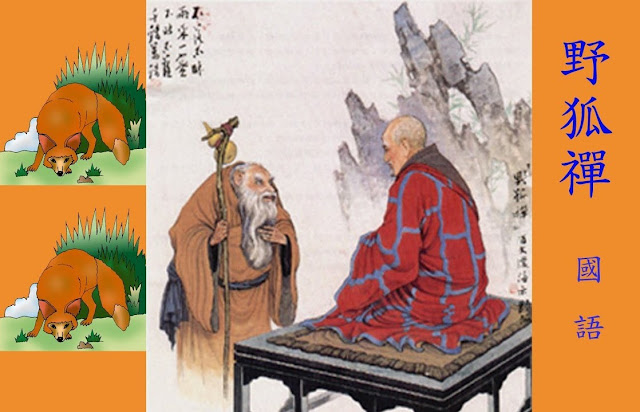
第二則  百丈野狐
百丈和尚凡參次,有一老人,常隨眾聽法,眾人退,老人亦退。忽一日不退,師遂問:「面前立者,復是何人?」老人云:「諾!某甲非人也。於過去迦葉佛時,曾住此山,因學人問:『大修行底人還落因果也無?』某甲對云:『不落因果。』五百生墮野狐身。今請和尚代一轉語,貴脫野狐。」遂問:「大修行底人還落因果也無?」師云:「不昧因果。」老人於言下大悟,作禮云:「某甲已脫野狐身,住在山後,敢告和尚,乞依亡僧事例。」師令維那白槌告眾:「食後送亡僧!」大眾言議:「一眾皆安,涅槃堂又無人病,何故如是?」食後,只見師領眾,至山後巖下,以杖挑出一死野狐,乃依火葬。師至晚上堂,舉前因緣,黃蘗便問:「古人錯祇對一轉語,墮五百生野狐身;轉轉不錯,合作箇甚麼?」師云:「近前來,與伊道。」黃蘗遂近前,與師一掌,師拍手笑云:「將謂胡鬚赤,更有赤鬚胡。」
無門曰:「不落因果,為甚墮野狐?不昧因果,為甚脫野狐?若向者裏著得一隻眼,便知得,前百丈贏得風流五百生。」
頌曰:「不落不昧,兩采一賽;不昧不落,千錯萬錯。」

Wumenguan Translation Comparison: Case 2: Commentary

PR. Paul Reps. "The Gateless Gate" in Zen Flesh, Zen Bones. 1934.
RHB. R.H. Blyth. Zen And Zen Classics: Volume Four: Mumonkan. 1966.
ZS. Zenkei Shibayama. The Gateless Gate. 1974.
KS. Katsuki Sekida. The Gateless Gate or The Gateless Barrier (Chin. Wu-wen kuan; Jap. Mumonkan). 1977.
RA. Robert Aitkin. The Gateless Barrier: The Wu-Men Kuan (Mumonkan). 1991.
KY. Koun Yamada. Mumonkan (Gateless Gate). 2004.
JCC. J.C. Cleary. Wumen’s Gate: Translated from the Chinese Taishö Volume 48, Number 2005. 2006.
WW. Gregory Wonderwheel. The Gateless Checkpoint of the Zen Lineage Chan Zong Wumen Guan (J. Zen Shu Mumonkan). 2007-8.
PL. Paul Lynch. Wú Mén Guān: The Barrier That Has No Gate. 2010.
DH. David Hinton. No-Gate’s Gateway. 2018.
CD. Catherine Despeux. La Passe Sans Porte de L’école Du Dhyâna.
SU. surupamaerl. Personal amateur translation to get a sense of what characters are available to translate from and whether the other translations are respecting the source. As such, I will be translating as literally as I can manage.

COMMENTARY

無門曰。
不落因果。
為甚墮野狐。
不昧因果。
為甚脫野狐。
若向者裏著得一隻眼。
便知得。
前百丈贏得。
風流五百生。

PR. Mumon's comment: "The enlightened man is not subject." How can this answer make the monk a fox? "The enlightened man is one with the law of causation." How can this answer make the fox emancipated? To understand this clearly one has to have just one eye.

RHB. "Not falling into the law of Cause and Effect"—for what reason falling into a fox-life? "Not setting aside the Law of Cause and Effect"—for what reason being released from a fox-life? If in regard to this you have the one (Buddha-)eye, then you understand the former Hyakujō's (= the old man's) dramatic five hundred reincarnations that he received.

ZS. Mumon's commentary: "Not falling into causation." Why was he turned into a fox? "Not ignoring causation." Why was he released from the fox body? If you have an eye to see through this, then you will know that the former head of the monastery did enjoy his five hundred happy blessed lives as a fox.

KS. Mumon's Comment: Not falling under causation: how could this make the monk a fox? Not ignoring causation: how could this make the old man emancipated? If you come to understand this, you will realize how old Hyakujõ would have enjoyed five hundred rebirths as a fox.

RA. Wu-men’s Comment: “Not falling under the law of cause and effect.” Why should this prompt five hundred lives as a fox? “Not evading the law of cause and ef ect.” Why should this prompt a return to human life? If you have the single eye of realization, you will appreciate how old Pai-chang lived five hundred lives as a fox as lives of grace.

KY. Mumon's Commentary: Not falling under the law of cause and effect - for what reason had he fallen into the state of a fox? The law of cause and effect cannot be obscured - for what reason has he been released from a fox's body? If in regard to this you have the one eye, then you will understand that the former Hyakujô enjoyed 500 lives of grace as a fox.

JCC. Wumen said, [When the wild fox monk asserted that the person of great practice] “does not fall into cause and effect,” why did he fall into a wild fox’s body? [When he heard that such a person] “is not deluded by cause and effect,” why did he shed the fox’s body? If you can focus the eye [of enlightened insight] here on this, then you will know why, long ago on Baizhang Mountain, [the old man] won for himself five hundred lifetimes flowing with the wind.

WW. Wumen Says: Why does “not falling into cause and effect” result in falling into a wild fox? Why does “not in the dark about cause and effect” result in taking off the wild fox? If from within you are able to manifest the one single eye, then you get the wisdom of how the first Baizheng won five hundred graceful lives.

PL. Not falling under causation: how could this make the monk a fox? Not ignoring causation: how could this make the old man emancipated? If you come to understand this, you will realize how old Báizhàng would have enjoyed five hundred rebirths as a fox.

DH. No-Gate’s Comment: Not tangled in karmic law: how could that make someone a fox roaming the countryside? Not free of karmic law: how could that liberate someone from a fox’s body? You here before me in this sangha: if you can reveal this wholly with Buddha-eye clarity, you’ll understand how old Hundred-Elder grew rich frolicking like wind-drift through five hundred lifetimes.

CD. Commentaire De Sans-Porte: « Il ne tombe plus dans la production des causes et des effets » est une réponse qui l’a fait chuter dans la destinée de renard, alors que la réponse « il n’est pas obscurci par les causes et les effets » l’a délivré de sa condition de renard. Si, à cet endroit, vous avez l’œil, vous apprécierez comment Cent-Toises a vécu en tant que renard cinq cents vies comme des vies de grâce.

SU. Wumen said: Letting cause and effect slide manifests as falling [into a] wild fox [body]; not being oblivious of cause and effect manifests as escaping from a wild fox [body]—if, all along, [you are one] involved in the internal use of the one single eye, in that case [you will] know the reason the former Baizhang won five hundred outstanding lives.

Note: It is unclear whether "the former Baizhang" refers to the old man who lived on Mt. Baizhang or the Master Baizhang (who is, after all, only referred to as "The Master" throughout the case).

I want to say "let slide" cause and effect, translating 落 as "leaving behind" or "forgetting about". "Falling into" is still a possibility that fits with the context though. My sound would be là while the other would be luò. luò would rhyme with the other characters in the poem, but "let slide" mirrors "not ignorant about" better.

I still wonder if "use" would not be better as "application" for 著.

I reread my translation for the six or seventh time wondering two things; why are most people framing it as questions, and what is this talk of wind? I don't see them anywhere in the Chinese after yet another read-through. It doesn't change the meaning all that much, though.

I'm also not opposed to "old Báizhàng", although I think it makes it too clear to whom Wumen is referring, and I am really not sure, and neither are some others that confident.

As such, as usual Reps is missing parts. Shibayama's "head of monastery" and Sekida's "enjoyed" may be a tiny bit extra. I agree with those whose "eye" is used and had, rather than just saying "seeing into..." or whatever. Cleary is just well written and clear.


二 百丈野狐
  百丈和尚。凡參次有一老人。常隨眾聽法。眾人退老人亦退。忽一日不退。師遂問。面前立者復是何人。老人云。諾某甲非人也。於過去迦葉佛時。曾住此山。因學人問。大修行底人還落因果。也無。某甲對云。不落因果。五百生墮野狐身。今請和尚。代一轉語貴。脫野狐遂問。大修行底人還落因果。也無。師云。不昧因果。老人於言下大悟。作禮云。某甲已脫野狐身。住在山後。敢告和尚。乞依亡僧事例。師令無維那白槌告眾。食後送亡僧。大眾言議。一眾皆安涅槃堂。又無人病。何故如是。食後只見師領眾。至山後巖下。以杖挑出一死野狐。乃依火葬。師至晚上堂。舉前因緣。黃蘗便問。古人錯祇對一轉語。墮五百生野狐身。轉轉不錯。合作箇甚麼。師云。近前來與伊道。黃蘗遂近前。與師一掌。師拍手笑云。將謂。胡鬚赤更有赤鬚胡。
無門曰
  不落因果。為甚墮野狐。不昧因果。為甚脫野狐。若向者裏著得一隻眼。便知得。前百丈贏得。風流五百生。
頌曰
  不落不昧 兩采一賽 不昧不落 千錯萬錯

Wumen's Pass: Case 2
百丈野狐

百丈和尚。凡參次有一老人。常隨眾聽法。眾人退老人亦退。忽一日不退。師遂問。面前立者復是何人。

Baizhang's Wild Fox
Every time Master 百丈 Baizhang [held] assembly, there was one old man who always followed the crowd to listen the Teaching1 . [When] everyone left, the old man also left. Suddenly, one day he did not leave. The Master thereupon asked, "Who is this one who is standing in my presence again?

老人云。諾某甲非人也。於過去迦葉佛時。曾住此山。因學人問。大修行底人還落因果。也無。某甲對云。不落因果。五百生墮野狐身。今請和尚。代一轉語貴。脫野狐[...]
The old man said, "Allow that this certain person is not human! In the past, in the time of Buddha Kasyapa, I once dwelled in these mountains. Because a student asked, 'Does a man whose background in Buddhist practice is great still fall into cause and effect, or not?' [and] this certain person replied, saying, 'No, [such a man] does not fall into cause and effect,' [for] five hundred births I fell into the body of a wild fox. Today I [politely] ask the Master to substitute a turning word [so that I may be] worthy of escaping this wild fox body."

[…]遂問。大修行底人還落因果。也無。
Finally, [the old man] asked, “Does a man whose background in Buddhist practice is great still fall into cause and effect, or not?”

師云。不昧因果。老人於言下大悟。作禮云。某甲已脫野狐身。住在山後。敢告和尚。乞依亡僧事例。
The Master said, “He is not ignorant of cause and effect.” By these words, the old man arrived at a great awakening. After bowing, he said, “This certain person has already shed this wild fox body; it lies in-behind the mountain.” [Then] he boldly requested of the Master, “I beg [you to treat] the deceased according to the typical custom of a monk.”

師令維那白槌告眾。食後送亡僧。大眾言議。一眾皆安涅槃堂。又無人病。何故如是。
The Master issued a command [to the] duty-distributor2 [to bang the] white [funerary] mallet and inform the people [that] after they had eaten [they would be] seeing off a dead monk. The great crowd spoke, commenting that, "All the people, in all cases, are in good health, and the infirmary3 is also uninhabited by illness. [For] what reason [will there be a funeral]?"

食後只見師領眾。至山後巖下。以杖挑出一死野狐。乃依火葬。師至晚上堂。舉前因緣。
After eating, merely to see, the Master led the people behind the mountain to the bottom of a cliff. Using his staff, he dug out4 a single dead wild fox, and thereupon cremated it according to [the typical custom of a monk]. [When] the Master arrived that evening in the main hall, he raised the antecedent causes [for the events that transpired].

黃蘗便問。古人錯祇對一轉語。墮五百生野狐身。轉轉不錯。合作箇甚麼。師云。近前來與伊道。黃蘗遂近前。與師一掌。師拍手笑云。將謂。胡鬚赤更有赤鬚胡。
Soon afterwards, Huangbo asked, "[Since] the ancient missed only one correct turning word and fell into five hundred births in a wild fox body, what if at every opportunity [he] was correct and it was regarded, [like your own turning word], as fitting?" The Master said, "Come closer to me to take part in his path." Huangbo complied, coming closer and slapping the Master once. The Master clapped his hands and laughed, saying, "[I] was going to speak of the foreigner with a red beard—still, there exists a red-bearded foreigner."
無門曰。不落因果。為甚墮野狐。不昧因果。為甚脫野狐。若向者裏著得一隻眼。便知得。前百丈贏得。風流五百生。
Wumen said: Letting cause and effect slide manifests as falling [into a] wild fox [body]; not being oblivious of cause and effect manifests as escaping from a wild fox [body]—if, all along, [you are one] involved in the internal use of the one single eye, in that case [you will] know the reason the former Baizhang won five hundred outstanding lives.
頌曰。不落不昧 / 兩采一賽 / 不昧不落 / 千錯萬錯

[The] eulogy said:
overlooking—attentive5
two wins, one competition6
mindful—oblivious
one thousand blunders, ten thousand mistakes
...
1 (lit. Dharma)
2 (lit. karmadana)
3 (lit. Nirvana hall)
4 (lit. poke)
5 (lit. "not falling, not ignorant". The third line is this reversed)
6 (两彩一赛 is a Chinese idiom, referencing gambling, whereby two people competing both win the prize, making the better competitor difficult to distinguish)