Wikipedia

Search results

Friday, August 6, 2021

Inter-dimensional Journey
䷷ 56異次元
I, interdimensional being

Augsburger Wunderzeichenbuch, Folio15, Vision des Hesekiel

Merkabah, also spelt Merkaba (光靈體), is the divine light vehicle (यान • yā́na/乘) allegedly used by ascended masters ― like R.A.M. ― to connect with and reach those in tune with the higher realms.
  • "Mer" means Light, 光, Sea of Light.
  • "Ka" means Spirit, 靈, It-spinning.
  • "Ba" means Body, 體, Double.
  • "Mer-Ka-Ba" ― 光靈體 ― means the spirit/body surrounded by counter-rotating fields of light, (wheels within wheels), spirals of energy as in DNA, which transports spirit/body from one dimension to another.
מֶרְכָּבָה • (merkavá) 

The Merkabah was thought to be a divine light vehicle (a spiritual space ship of sorts) that transported/shifted people/spirit from one dimension to another and thus enabled people/foci of consciousness to access, connect with and communicate with beings of other dimensions. It is counter-rotating fields of light in the shape of two interlocked tetrahedra, where one point of the tetrahedra points up and the other points down, forming the shape of a star tetrahedron. This is why it is referred to as the chariot of ascension.
  • When viewed, it looks like a three dimensional Star of David.
  • Why does it look like the Star of David?
  • Because the Star of David came about as a result of people observing the Merkabah phenomena.
This is why the Star of David among other things, represents the idea of the soul transcending the temporal world. Even though mankind has witnessed the Merkabah since spiritual curiosity arose, the Merkabah made its major debut in human consciousness before Jesus was born amongst those who practised early Jewish mysticism. It showed up in their visions. They began calling it Merkabah, which means “to ride” or “thing to ride in” depending on its usage. They believed it to be a spiritual chariot of sorts. Amongst religious scholars of that time, it was hailed as a chariot of the gods.
Kabbalistic Tree of Life

The Merkabah became a secret doctrine, only known to few. A few rabbi, mystics and philosophers preserved the knowledge while many others forbid its study. Over the years, scholars and prophets and spiritual leaders have come up with their own separate ideas about what the Merkabah is and about how to utilize it. Many of them of course have never seen the Merkabah and so they believe that it is more of a metaphor rather than an actuality. Fast forward and now, here we are in a world where no one agrees about the Merkabah.

It has long been thought by believers in the actuality of the Merkabah that this inter-dimensional light vehicle is located in each person’s base chakra (मूलाधार or मूलाधारा Mūlādhāra, lit. "root of Existence." Mula means root and Dhara means flux) or the root chakra (चक्र cakrá wheel, cycle) that when activated, expands to encompass their body. It is thought that the Merkabah can be activated through the use of breathwork techniques or spinning techniques, or certain eye movements or mudras. The average human brain does not believe that consciousness can exit and enter this dimension at will with no “vehicle” because it understands travel only in terms of physical movement. It understands travel as to go somewhere else, only in terms of a vehicle or craft. So the human brain has interpreted the Merkabah as a vehicle when it is nothing of the sort. It is a geometric pattern that can move either like a torus or like counter-rotating light fields. The energy field of a person, which is always present, takes on this pattern when their consciousness is no longer purely focused physically and is now able to travel or is travelling through other dimensional realities. We can take this one step further though. A fully activated Merkabah indicates that a person is able to take their body through stargates and to other dimensional realities, instead of simply take their consciousness to other dimensional realities whilst leaving their body behind.

The fully activated Merkabah indicates that a person is able to transform the entire body into light. It is a form of light travel. In other words, in the final stages of Merkabah activation, through a shift in consciousness, the triad of the mind, spirit and body completely integrates into one pattern of light and is then able to transcend the limitation of the physical time-space reality. The concept of the Merkabah was brought to the attention of early mystic scholars by the Annunaki beings that had relocated to the area of our universe that we call Sirius. There was no other way for these early scholars to conceptualize extraterrestrial beings or space travel. They saw the rest of the universe as heavens and these beings as gods. And so, the Merkabah was seen as a chariot of the gods. Here’s the problem; human beings began to think that the Merkabah was a prerequisite for “ascension”. It is not; it is the result of ascension. Ascension is nothing more than the process of altering the perspective to one that takes in more of an objective point of view of the universe we live in and of life itself. And there are a billion and a half techniques that aid a person to shift their perspective.
  • It is thought that prohibits a person from experiencing anything more than the physical dimension.
  • It is thought that enables a person to experience more than the physical dimension.
Thought is the inter-dimensional vehicle. This is why the most beneficial teachers of ascension, are focused on one primary thing, and that is to help people to develop flexibility and an openness of mind. That is to help people to commandeer ascension their focus. He, who plays with thought, plays with the very matrix of this universe. I cannot activate the Merkabah so that the Merkabah itself can assist me to reach other dimensions or ascend. Instead, the Merkabah “activates” on its own as a result of shifting consciousness. It is a symptom of increasing the vibration of consciousness, not a cause of increasing consciousness. The Merkabah “becomes alive”. And it became alive, which means the energy field of a person reflects the fact that they have developed a pattern of consciousness that enables their perspective to be unrestricted by the limitations of the vibrational density of the physical dimension.

Interdimensional Travel

Chakra Journey
  • The triangle is a pattern we see that emerges as a result of directed consciousness that is experienced as a movement.
  • The triangle is also a pattern that emerges as a result of the desire to merge the body, mind and spirit.
These are the two primary reasons that the Merkabah takes on the interlocking triangular structure that it does. If we continue our spiritual practice ― by expanding with the natural progression of spiritual learning ― it is inevitable that the Merkabah will activate. In other words, it is inevitable that the Merkabah will become alive. We do not have to “go anywhere” to travel inter-dimensionally:
不出戶知天下;不闚牖見天道。
其出彌遠,其知彌少。
是以聖人不行而知,不見而名,不為而成。
道德經第四十七章
That is the physical understanding of movement and travel.
When it comes to inter-dimensional “travel”, the process depends on two principles, intention and attention. It is a three-step process using these two principles:
  1. First, we set our intention
  2. Then we place our attention on things related to that intention.
  3. Then we merge attention and intention by focusing the energy of our intention towards the end result of our desire.
In summation, the Merkabah is the pattern and structure that the human light body takes on when one’s consciousness is ready for or is participating in inter-dimensional “travel”. This pattern, once activated, begins to appear near the base chakra and emanates upward forming a torus around the body, which then gradually transforms into the star tetrahedron shape that we call, the Merkabah.
Orphic Egg
Christian depiction of the four "animal" symbols of the Evangelists

מֶרְכָּבָה • (merkavá) f (plural indefinite מַרְכָּבוֹת‎, singular construct מִרְכֶּבֶת־‎, plural construct מַרְכְּבוֹת־‎)
  • carriage, hansom, chariot 
  • the Divine Chariot (Kabbalah) 
a. 217 C.E., Mishnah, Chagigah 2:1:
‏אֵין דּוֹרְשִׁין בַּעֲרָיוֹת בִּשְׁלֹשָׁה, וְלֹא בְמַעֲשֵׂה בְרֵאשִׁית בִּשְׁנַיִם, וְלֹא בַמֶּרְכָּבָה בְּיָחִיד, אֶלָּא אִם כֵּן הָיָה חָכָם וּמֵבִין מִדַּעֲתּוֹ.‎‎
Ein dorshín ba-'arayót bi-shloshá, v-lo v-ma'asé v'reishít bi-shnáyim, v-lo va-merkavá b-yaḥíd, éla im ken hayá ḥakhám umevin mida'ato.
One may not expound on forbidden sexual relations in front of three, nor the matter of creation in front of two, nor the Chariot before one unless one is wise and understanding of one's knowledge. 

The noun מֶרְכָּבָה • Merkabah/Merkavah "thing to ride in, cart" is derived from the consonantal root ר־כ־ב‎ r-k-b with the general meaning "to ride". The word "chariot" is found 44 times in the Masoretic Text of the Hebrew Bible — most of them referring to normal chariots on earth, and although the concept of the Merkabah is associated with Ezekiel's vision (1:4–26), the word is not explicitly written in Ezekiel 1.

However, when left untranslated, in English the Hebrew term Merkabah/Merkavah (Hebrew: מֶרְכַּב‎, מרכבה‎, and מִרְכֶּבֶת‎) relates to the throne-chariot of God in prophetic visions. It is most closely associated with the vision in Ezekiel chapter 1 of the four-wheeled vehicle driven by four חַיּוֹת ḥayyōṯ ("living creatures"), each of which has four wings[5] and the four faces of a man, lion, ox, and eagle (or vulture).
道德經第六十三章

The Laugh, Mark Bryan

為無為,事無事,味無味。
大小多少,報怨以德
圖難於其易,為大於其細;
天下難事,必作於易,
天下大事,必作於細。
是以聖人終不為大,故能成其大。
夫輕諾必寡信,多易必多難。
是以聖人猶難之,故終無難矣。

Dào De Jing Chapter 63 ― A. Charles Muller, 63. Do without "doing" ...

Do without "doing."
Get involved without manipulating.
Taste without tasting.
Make the great small,
The many, few.
Respond to anger with virtue.
Deal with difficulties while they are still easy.
Handle the great while it is still small.
The difficult problems in life
Always start off being simple.
Great affairs always start off being small.
Therefore the sage never deals with the great
And is able to actualize his greatness.
Now light words generate little belief,
Much ease turns into much difficulty.
Therefore the sage treats things as though they were
difficult,
And hence, never has difficulty.

Dào De Jing Chapter 63 ― Arthur Waley

It acts without action, does without doing,
Finds flavour in what is flavourless,
Can make the small great and the few many,
“Requites injuries with good deeds,
Deals with the hard while it is still easy,
With the great while, it is still small.”
In the governance of an empire everything difficult
Must be dealt with while it is still easy,
Everything great must be dealt with while it is still small.
Therefore the Sage never has to deal with the great;
And so achieves greatness.
But again “Light assent inspires little confidence
And 'many easies' means many a hard.”
Therefore the Sage knows too how to make the easy difficult,
And by doing so avoid all difficulties!

Dào De Jing Chapter 63 ― James Legge (Thinking in the beginning)

(It is the way of the Dao) to act without (thinking of) acting; to conduct affairs without (feeling the) trouble of them; to taste without discerning any flavour; to consider what is small as great, and a few as many; and to recompense injury with kindness.
(The master of it) anticipates things that are difficult while they are easy, and does things that would become great while they are small. All difficult things in the world are sure to arise from a previous state in which they were easy, and all great things from one in which they were small. Therefore the sage, while he never does what is great, is able on that account to accomplish the greatest things.
He who lightly promises is sure to keep but little faith; he who is continually thinking things easy is sure to find them difficult. Therefore the sage sees difficulty even in what seems easy, and so never has any difficulties.


The Kow, the Léon & the Tyger

अर्धनारीश्वर Ardhanārīśhvara (शिव-पार्वती Shiva-Parvati) कैलाश राज Kailash Raj
अर्धनारीश्वर, Ardhanārīśwara (Siva Parvati)

➥ Cow/Ox ≍ Mॐ/गाय gāy/Γαῖα, Γῆ Gē "R.A. Lair Gay 2404"
  • The cow symbolizes wealth, compassion, motherliness, righteousness (dharma), motherhood, divinity, sattvic nature, sacrifice, service, purity, and auspiciousness. In ancient India, a person’s social and economic status depended upon the number of cattle he possessed. One of the prime duties of the students in ancient India who studied the Vedas in the गुरुकुलों gurukuls was to help their teachers by looking after their cows. From the उपनिषदों Upanishads, we know that served their teachers by taking their cows into the forest for grazing and returned in the evening. भगवान कृष्ण Lord Krishna grew up in a family of cowherds and personally tended the cows and other domestic animals in his childhood. The पुराणों Puranas suggest that the animals and friends around him were mesmerized by the melody of his flute and stayed calm. कृष्ण Shiva is known as गोरखनाथी Gorakhnath, means the lord of the cows. He is also known as, पसुपतिनाथी Pasupathinath, the lord of all animals. According to some scholars, कृष्ण Shiva’s association with cows and bulls might date back to the सिंधु घाटी Indus Valley period. Cows have a special significance in हिन्दू धर्म Hinduism, as aspects of Mother Goddess and as symbols of selfless service. 
  • Images of bulls were found in several सिंधु घाटी की मुहरें Indus Valley seals. They suggest that since the earliest times bulls had a socio-religious significance in ancient India. In the वैदिक Vedic world, the bull represented masculinity, virility, strength, aggression, and fighting power. The Sanskrit word वृषण vrishan, derived from the root world, वृषो vrish, was originally used in the वेद Vedas to denote all males, including men. However, another of its derivatives, वृषभ Vrishabha was used to denote various types of bulls, including horse bulls and male boar. The वेद  Vedas describe इंद्र Indra as a strong bull of manliness and mighty strength. They also signify the sexual prowess of the bulls by stating that अग्नि Agni or इंद्र Indra descend from heaven to earth roaring like a husband to his wives. The bull has a special significance in शैव Shaivism and हिंदू तंत्र Hindu Tantra. भगवान शिव Lord Shiva is known as वृषभनाथी Vrishabhanath, lord of the bulls. His vehicle is नंदी Nandi, the divine bull, also known as बसव Basava, who is worshipped by devotees individually as a personal god and in association with शिव Shiva as his vehicle. According to some, नंदी Nandi is not a bull in the ordinary sense, but a divine being, and a close confidant of भगवान शिव Lord Shiva, whose anthropomorphic form is represented by a half-human and half bull body. He is known for his knowledge, devotion, obedience, surrender, virtue, and dedication to शिव Shiva and his devotees of शिव Shiva, and fought many battles to protect the gods, slay the demons and uphold dharma. However, in Hinduism bulls symbolically represent both positive and negative qualities. On the positive side, they represent manliness, virility, manly strength, sexual prowess, and fighting spirit. On the negative side, they symbolize darkness, brute power, excessive sexuality, lust, anger, aggression, promiscuity, waywardness, ignorance, and delusion. On specific occasions, हिंदुओं Hindus worship bulls and make them offerings of food. Since they are considered sacred, as in the case of cows, hurting or harming them is strictly prohibited in हिन्दू धर्म Hinduism.
  • One of the seals found in the सिंधु घाटी Indus Valley shows a seated deity in a yoga posture with the horns of a buffalo. It refers to the possibility that in those days, buffalo horns signified a person’s social status, royalty, authority, or divinity. Some of the seals show human figures in a conflict with a buffalo figure, who may be a prototype of a buffalo demon or a rival king. The वेदों Vedas contain references to the buffalos and their ritual significance. The buffalo is a savage beast. Unlike the cow, it has a dark mane, and a gross body, suggestive of its तामसिक tamasic (resistant, dark and destructive) nature. However, buffalos in हिन्दू धर्म Hinduism represent both positive and negative qualities. On the negative side, buffalos represent darkness (तमस tamas), delusion, ignorance, lust, demonic nature and brute power. On the positive side, they represent strength, divinity, support, and ferocity. The water buffalo is the vehicle of भगवान यम Lord Yama, the lord of the underworld, who is regarded as the lord of justice. महिष Mahisha is a buffalo god whereas महिषासुर Mahishasura is a buffalo demon. The he-buffalo (महिष Mahisha) represent a king, or the ruler of the earth, while the she-buffalo (महिषियो Mahishi) his wife. Hence, the first wife of a king in Hinduism is called पत्ता महिषी Patta Mahishi. In the वैदिक Vedic ritual of horse sacrifice (अश्वमेध यज्ञ Asvamedha yajna) she used to have a prominent role as the sacrificial offering to the divine horse, ब्रह्म Brahman. महिषासुर Mahishasura, who represents the brute force of the he-buffalo was a powerful demon who became a tormentor of the worlds. None of the male gods could defeat him due to a boon he obtained. He was eventually killed by दुर्गा Durga, the Mother Goddess. In a broader sense, the buffalo symbolizes all mortal beings who live upon the earth and who are a mixture of both positive and negative qualities. According to कालिका पुराण Kalika Purana, a buffalo is an auspicious animal with an excellent form that gives life, wealth and fame. There is a story in devotional हिन्दू धर्म Hinduism, according to which a saint named ज्ञानेश्वर Jnaneshwar once taught the वेदों Vedas to a buffalo to prove that the same spirit pervaded all and existed in all. One may not take that story literally, but it does point to an important belief of हिंदुओं Hindus and their attitude towards animals. Both commercially or spiritually, the buffalo is not as popular as the cow or the bull, but it has its own place in हिन्दू धर्म Hinduism. Compared to the cows and the bulls, the buffalos are sturdier and better suited to the harsh conditions of temperate climate. Hence, they are widely used in rural India as beasts of burden and in the cultivation of lands. Traditionally, buffalos have been used in वैदिक Vedic rituals, next to the horse, and offered as a sacrifice to appease gods. They are also the main sacrificial animals in the worship of शक्ति Shakti, especially during the दुर्गा पूजा Durga puja. However, although buffalos are sacrificed during rituals, as in the case of cows and bulls हिंदुओं Hindus are prohibited from eating buffalo meat.
➥ Tiger hide ≍ Pop's Pride "R.G. Gay 2707"
  • There are no references to बाघों/वियाघर tigers in the ऋग्वेद Rigveda. However, यजुर्वेद Yajurveda and अथर्ववेद Atharvaveda contain a few references to them. They contain prayers and spells to subdue tigers and protect people, cowherds and shepherds from the menace of tigers, besides invocations that extol gods by ascribing to them the power and the qualities of tigers. For example, a hymn (5.7) in the  यजुर्वेद Yajurveda to रुद्र Rudra and अग्नि Agni describes that they possess the ferocity of a tiger. Another hymn (5.21) suggests that a tiger is worthy of sacrifice to इंद्र Indra. In some hymns, the domestic fires are compared to the tigers that guard the house. भगवान शिव Lord Shiva is shown to wear tiger skin. Indian forests were home to Asiatic tigers. Tiger hunting was a favourite royal sport. Kings were allowed to hunt them to protect the people from their menace. Vedic humans unambiguously described the tiger as the foremost animal among the beasts of prey. A spell (4.6) from the अथर्ववेद Atharvaveda suggests that in rural areas tigers and lions were a menace to the cattle owners as they frequently attacked their cattle and carried them away. Tigers also figure prominently in many Indian folk-tales, जातक Jataka-stories, and the पंचतंत्र Panchatantra. Like elephants, tigers represent royalty, majesty, fearlessness, strength, and ferocity. On the negative side, they represent death, aggression, anger, cruelty, and violence. The tiger is the most popular and well-known vehicle of शक्ति Shakti and her numerous manifestations. In the images and sculptures, she is shown as riding or sitting upon a tiger. Spiritually, tigers are considered advanced beings. Some of them might be humans in their past lives or may assume a human birth in their next lives. For example, मनुस्मृति Manusmriti (12.59) declares that those who take pleasure in hurting others will be born as carnivorous animals such as tigers, whereas those who eat forbidden food become worms. In many tribal traditions of इंडिया India, the tiger (or lion) is worshipped as a god. The गोंड Gonds in Central India worship a tiger god named बाग देव Bagh Deo, who is considered the saviour and protector of his devotees. The मुरियास Murias worship चित्तन देव Chitan Deo, who is a hunting tiger god, while the भारियासो Bharias worship भागेश्वरी Bhageshwar. Worship of the tiger god under different names is prevalent in many other tribes of India.
  • Lions and tigers enjoy an exalted status in हिन्दू धर्म Hinduism as symbols of royalty, strength, and ferocity. However, because of the large size of their population and their wider geographical presence, tigers receive more attention and religious importance than lions. One of the ten incarnations of विष्णु Vishnu is नरसिंह Narasimha, who has the head and shoulders of a lion, but the torso of a human. नरसिंह Narasimha is one of the fiercest forms of विष्णु Vishnu in his aspect of कला Kala, or Death. He manifested as a lion to destroy the demon king, हिरण्यकश्यपु Hiranyakasipu and save his son प्रहलाद Prahlada from his father’s abuse. Many शक्तिसी Shaktis have either a lion or a tiger, or both as their vehicles, suggesting that from a symbolic perspective they represent the same qualities and energies. Lions are mentioned in the वेदों Vedas and the पुराणों Puranas. देवी दुर्गा Goddess Durga, a fierce form of पार्वती Parvathi or शक्ति Shakti, has a golden lion as her vehicle, while राहु Rahu, a planetary guard, rides upon a black lion as his vehicle. Like the tigers and elephants, lions represent royalty, ferocity, majesty, strength, courage and commanding power. Lions form an important part of हिंदू Hindu religious art. The face of the lion (सिंह-मुख Simha-Mukha) is used in images and sculpture in many हिंदू Hindu temples to decorate the doors, walls, arches, and windows. Their fierce form, bloodshot eyes, and large teeth represent कला Kala, the devourer. A similar form is used in the masks, कीर्ति मुखा Kirti Mukhas, which are worn by actors in traditional हिंदू Hindu dance dramas to enact ancient legends and stories from the पुराणों Puranas and the epics. Lions also appear in the art of ancient इंडिया India as symbols of royal authority. The memorial pillar at सारनाथी Saranath which was erected by अशोक Ashoka after his conversion to Buddhism contains four beautifully carved standing lions at the top on a round abacus representing the imperial power. They now constitute the official emblem of the government of इंडिया India.
भगवान शिव Lord शिव Shiva and Tiger Skin
― The Reason why Shiva wears a Tiger's hide
Or why शिव śivá, “the auspicious one” hides His nudity below the hide of a Tyger
व्याघ्र vyāghrá, “tiger”

भगवान शिव Lord Shiva is usually depicted as sitting or meditating on a tiger skin and usually portrayed as wearing a tiger skin for a garment. Tiger symbolically represents power.
That शिव Shiva sits on a tiger's skin and wears it, symbolically, means that He is beyond all power and dominates over all the powers.
There is an interesting story in the शिव पुराण Shiva Purana which narrates about how भगवान शिव Lord Shiva got the tiger skin.

Once भगवान शिव Lord Shiva was roaming around the world as an अवधूत Avadhūta. He was completely naked and was so immersed in this meditation that he was unaware of any other existence. During that roaming, He reached a forest inhabited by a group of saints who lived along with their families. The arrival of a naked mendicant created a flutter within their small and confined society. The women in the community were attracted by शिव Shiva and there was some disturbance in the daily routines of the आश्रम āśrama, Ashram. Upon realizing that it was the new mendicant that was responsible for the wayward behaviour of the females in their society, the saints became furious and decided to teach that young beggar a lesson and consequently dug a pit on his usual way. As भगवान शिव Lord Shiva passed over the pit, the saints, using their powers, created a tiger which was easily overpowered by शिव śivá that removed the hide and made cloth out of it. The saints  realizing that the mendicant was no ordinary Avadhuta ― prayed for forgiveness. भगवान शिव Lord Shiva appeared and blessed them. From that day onwards शिव Shiva started wearing the tiger's skin.

Thursday, August 5, 2021

Lease, Bail, Jail & Jailbait

Confined to this Gaol
Set in Mother Gaul
To which ultimate Goal?

With White & Black Sails set on
I Hear the Sirens' Songs
Lured by their enchanting music and singing voices
Jailbaits all!

As Myrddin*
Beguiled by Viviane
Incarcerated till his demise


In chivalric romance tradition, Merlin has a major weakness that leads him to his relatively early doom: young beautiful women of femme fatale archetype**. His fate of either demise or eternal imprisonment is set by Viviane (of which the most primitive French form might be Niniane, ultimately derived from (and corruption of) the Welsh word chwyfleian (also spelt hwimleian, chwibleian, et al. in medieval Welsh sources), meaning "a wanderer of pallid countenance", which was originally applied as an epithet to the famous prophetic "wild man" figure of Myrddin Wyllt (a prototype of Merlin) in medieval Welsh poetry. Due to the relative obscurity of the word, it was misunderstood as "fair wanton maiden" and taken to be the name of Myrddin's female captor.) the Lady of the Lake, who uses one of his own spells to rid of him.

The Beguiling of Merlin, by Edward Burne-Jones, 1872–1877

The lease is a written agreement that establishes the relationship of freeholder and leaseholder and sets out the contractual terms that are binding upon each person named on the lease.
A freehold property means one owns a property and land outright.
A leasehold property means one only owns a property for a fixed number of years.
The length of the lease is to be specified in the contract.
🡺 Leasehold – where one owns the right to occupy a property for a fixed number of years, typically 99 years or more, and one has the right to live in that property but will need to follow any rules laid down in the terms of the lease
Flats are often leasehold, but houses can be too.

Body Lease
At Birth 🡺 Birth Certificate 🡺 Custody of the Body
 🡺 Garde à Vue 🡺 Detainee 🡺 Inmate 🡺 Detention/Remand centre (Penitentiary)

Jail Time
Incarceration 🡺 Perpetuity 🡺 Death certificate 🡺 Release of the Body
        ➥ Unless benefiting from an early ReLease (Enlightenment/悟り)

Gaol Guardian (AnGaoL)
🡺 A tutelary angel watching over a particular person
🡺 Guardians of Ga'Hoole
Ga'
n. A term used by owls that means "Great Spirit," as in Ga'Hoole (Great Spirit of Hoole). The seeds of Ga' are said to be in every owl's gizzard, but rarely grows. Hoole had Ga', and the Great tree was named for the spirit of Ga'.
Hoole
n. The name of the first owl, and of Hoole, the first king of Ga'Hoole - the foster son of Grank and son of H'rath and Siv. Also means "first of a kind."
To prevent escape, prisons are normally surrounded by fencing, walls, earthworks, geographical features, or other multiple barriers, such as concertina wire, electrified fencing, secured and defensible main gates, armed guard towers, security lighting, motion sensors, dogs and roving patrols that may all also be present, depending on the level of security.

Bail Terms
Getting Out of Jail After an Arrest
 🡺 one must comply with "conditions of release."
Getting Out of Jail Free
 🡺 sometimes people are released "on their own recognizance," or "O.R." A defendant released on O.R. must simply sign a promise to show up in court and is not required to post bail.

** Goalbait/Jailbait

A sexually mature person (usually female) below the legal age of consent who is regarded (usually by an adult male) as being attractive and/or seductive. 
2009, The Economist, Charis Wilson, model and writer, died on November 20th, aged 95:
"The first time she modelled for Edward Weston, in March 1934, Charis Wilson knew she didn’t look good. At 20 she was “a piece of jailbait”, a mere child, especially with the stumpy plaits into which she sometimes twisted her hair."

《道德經 第六十二章


Hexagram 62 is named 小過 (xiǎo guò), "Small Exceeding".
Or "preponderance of the small" and "small surpassing".
Its inner trigram is ☶ (艮 gèn 52) bound = (山) mountain,
its outer trigram is ☳ (震 zhèn 51) shake = (雷) thunder.


道者萬物之奧
善人之寶,不善人之所保。
美言可以市,尊行可以加人。
人之不善,何棄之有?
故立天子,置三公,雖有拱璧以先駟馬,不如坐進此道。
古之所以貴此道者何?不曰:以求得,有罪以免耶?故為天下貴。

Dào De Jing Chapter 62  A. Charles Muller
62. The Way is hidden deeply in all things...

The Way is hidden deeply in all things.
It is the treasure of the good
And the refuge of the not-so-good.
With skilful words, you can be successful.
With honourable actions, you can be included.
People may not be so good, but how can you deny them?
Therefore, even though there are great jewels brought in by
teams of horses at the coronation of the emperor and the
installation of the three princes,
This is not as good as staying where you are
And advancing in this Way.
Why did the ancients so value the Way?
You can't say that it was for seeking gain
Or to have punishments to deter crime.
Therefore it is the most prized in the world.

Dào De Jing Chapter 62  Arthur Waley

Dào in the Universe is like the southwest corner in the house.
It is the treasure of the good man,
The support of the bad.
There is a traffic in speakers of fine words;
Persons of grave demeanour are accepted as gifts;
Even the bad let slip no opportunity to acquire them.
Therefore on the day of an Emperor's enthronement
Or at the installation of the three officers of State
Rather than send a team of four horses, preceded by a disc of jade,
Better were it, as can be done without moving from one's seat,
To send this Tao.
For what did the ancients say of this Tao,
How did they prize it?
Did they not say of those that have it
“Pursuing, they shall catch; pursued, they shall escape?”
They thought it, indeed, most precious of all things under heaven.

Dào De Jing Chapter 62  James Legge (Practising the Dao)

Dào has of all things the most honoured place.
No treasures give good men so rich a grace;
Bad men, it guards and doth their ill efface.

(Its) admirable words can purchase honour;
(its) admirable deeds can raise their performer above others.
Even men who are not good are not abandoned by it.
Therefore when the sovereign occupies his place as the Son of Heaven,
and he has appointed his three ducal ministers,
though (a prince) was to send in a round symbol-of-rank large enough to fill both the hands
and that as the precursor of the team of horses (in the court-yard),
such an offering would not be equal to (a lesson of) this Dao, which one might present on his knees.
Why was it that the ancients prized this Dao so much?
Was it not because it could be got by seeking for it,
and the guilty could escape (from the stain of their guilt) by it?
This is the reason why all under heaven consider it the most valuable thing.

Wednesday, August 4, 2021


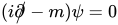
Dirac equation(natural units)

胡子無鬚

或庵曰。西天胡子。因甚無鬚。
無門曰。參須實參。悟須實悟。者箇胡子。直須親見一回始得。說親見。早成兩箇。
頌曰。癡人面前 / 不可說夢 /胡子無鬚 / 惺惺添懵

PR. A Beardless Foreigner
Wakuan complained when he saw a picture of bearded Bodhidharma: "Why hasn't that fellow a beard?"
Mumon’s comment: If you want to study Zen, you must study it with your heart. When you attain realization, it must be true realization. You yourself must have the face of the great Bodhidharma to see him. Just one such glimpse will be enough. But if you say you met him, you never saw him at all.
One should not discuss a dream/In front of a simpleton./Why has Bodhidharma no beard?/What an absurd question!

RHB. Wakuan's "Why No Beard?"
Wakuan said, "Why has the Western Barbarian no beard?"
Commentary: If you study Zen, you must really study it. If you become enlightened it must be the real enlightenment. If you once see the barbarian's real face intimately, then you have at last got "it". But when you explain what you saw, you have already fallen into relativity.
Before a fool,/Do not expound your dream./The beardless barbarian,-/It is adding obscurity to clarity!

ZS. The foreigner has no beard
Wakuan said, "Why has the foreigner from the West no beard?”
Mumon's commentary: Training in Zen has to be real training. Satori has to be real satori. You have to see this foreigner here clearly yourself; then you actually know him. If, however, you talk about "clearly seeing," you have already fallen into a dichotomy.
In front of a fool/talk of no dream./The foreigner has no beard:/it is adding stupidity to clarity.

KS. The Western Barbarian with No Beard
Wakuan said, "Why has the Western Barbarian no beard?"
Mumon's Comment: Study should be real study, enlightenment should be real enlightenment. You should once meet this barbarian directly to be really intimate with him. But saying you are really intimate with him already divides you into two.
Don't discuss your dream/Before a fool./Barbarian with no beard./Obscures the clarity.

RA. Huo-an’s Beardless Barbarian
Huo-an asked, “Why has the Western Barbarian no beard?”
Wu-men’s Comment: Practice must be true practice. Satori must be true satori. Once you see the Barbarian’s face intimately, at first hand, you have it at last. But when you explain this experience, you immediately fall into dualism.
Don’t discuss your dream/before a fool—/Barbarian with no beard!/That obscures the clarity.

TC. The Foreigner Has No Whiskers
Huo-an said, "Why has the Foreigner from the West no whiskers?"
Wumen says Study must be genuine study, enlightenment must be real enlightenment. This foreigner must be seen in person before you can understand; but when you talk about a personal meeting, there's already a dichotomy.
Wumen's Verse: In the presence of an ignoramus,/Do not talk about a dream./The foreigner having no whiskers/Adds obscurity to awareness.

KY. The Barbarian Has No Beard
Wakuan said, “Why has the western barbarian no beard?”
Mumon's Commentary: If you practice Zen, you must actually practice it. If you become enlightened, it must be the real experience of enlightenment. You see this barbarian once face to face; then for the first time, you will be able to acknowledge him. But if you say that you see him face to face, in that instant there is a division into two.
In front of a fool/Do not talk about dreams;/The barbarian has no beard:/It's adding obscurity to clarity.

JCC. The Barbarian Has No Beard
Huoyan said, “Why does the Indian barbarian have no beard?” [Why do enlightened teachers, and the enlightened true identity within us, have no fixed, predictable characteristics by which we may recognize them?]
Wumen said Study must be a real study. Awakening must be a real awakening. For this, you must see the barbarian in person. But when I say “see in person,” it has already become dualistic.
In front of fools,/We must not speak of dreams./“The barbarian has no beard”/Adds confusion to clear wakefulness.

WW. Mr Barbarian Without a Beard
Huoan said, "Mr Barbarian from the Western Heaven, why do you have no beard?"
Wumen Says: Meeting must be real meeting, awakening must be real awakening. (Alt. Meeting the beard is a real meeting, realizing the beard is a real realization.) Those who would encounter the barbarian son must see his beard intimately first hand one time and only then do they get it. But, if you speak about being intimate, you have already become two.
Before the face of a foolish person/You shouldn’t tell your dream,/“Mr Barbarian is beardless”/Is mouthing wakefulness.

DH. Western Barbarian No Beard
Master Doubt-Shrine Mountain asked: “Bodhidharma, the Western Barbarian with a red beard—how is it he had no beard?”
No-gate’s Comment: To penetrate depths, you must truly penetrate depths. To awaken, you must truly awaken. To meet the Barbarian, you must meet him eye to eye. Then, in that one moment, the two of you are indistinguishable. But say even so much as eye to eye, and already you’ve become two again.
You feel a fool facing him, with no idea/how to describe the dream. And this/Western Barbarian no beard stuff/only muddies all that startled clarity.

CD. Le barbare n’a pas de barbe
Huo’an (Wakuan) dit : « Pourquoi ce barbare venu de l’Ouest [Bodhidharma] n’a-t-il pas de barbe ? »
Commentaire De Sans-porte: Quand on s’applique à la résolution de ce cas, il faut s’y appliquer à fond. Quand on s’éveille, il faut s’éveiller réellement. Ce barbare, il faut le voir personnellement pour avoir quelque éveil. Dire qu’il faut le voir personnellement, c’est déjà tomber dans le dualisme.
En présence de l’imbécile,/Ne raconte pas ton rêve./Pourquoi le barbare n’a-t-il pas de barbe?/Cette question obscurcit ce qui était clair.

SU. The Bearded-Foreigner with No Beard
Huoan said, "The bearded-foreigner from India1, for what reason [does he have] no beard?"
Wumen said: Inquiry must be honest inquiry; awakening must be true awakening. This bearded-foreigner should be seen first-hand; only then will you obtain an answer—[but] speak of seeing first-hand, [and you have] established it as two parts.
When before an ignorant person,/you must not discuss a dream./The bearded-foreigner with no beard—/Clear-headed—increasingly muddled.
___________________________________________________________________________________

1 (西天 xītiān also means "Western Heaven" in some forms of Buddhism, notably in the Pure Land tradition)

Notes: For 參 I went with the Buddhist "inquiry", although "participation" seems to be fine; I believe Wumen's issue, as the last line of the verse, is that Huoan's question is stupid/misleading and/or made in bad faith, so the first two lines of the commentary can reflect that a number of ways (just as 實 could be "honest" or "real").

一回: could be "at once"

"Intimacy" for the second 親見 "close-meeting"

兩箇: too big too young


Wumenguan Translation Comparison: Case 4

PR. Paul Reps. "The Gateless Gate" in Zen Flesh, Zen Bones. 1934.
RHB. R.H. Blyth. Zen And Zen Classics: Volume Four: Mumonkan. 1966.
ZS. Zenkei Shibayama. The Gateless Gate. 1974.
KS. Katsuki Sekida. The Gateless Gate or The Gateless Barrier (Chin. Wu-wen kuan; Jap. Mumonkan). 1977.
RA. Robert Aitkin. The Gateless Barrier: The Wu-Men Kuan (Mumonkan). 1991.
TC. Thomas Cleary. Unlocking the Zen Koan: A New Translation of the Zen Classic Wumenguan. 1997.
KY. Koun Yamada. Mumonkan (Gateless Gate). 2004.
JCC. J.C. Cleary. Wumen’s Gate: Translated from the Chinese Taishö Volume 48, Number 2005. 2006.
WW. Gregory Wonderwheel. The Gateless Checkpoint of the Zen Lineage Chan Zong Wumen Guan (J. Zen Shu Mumonkan). 2007-8.
DH. David Hinton. No-Gate’s Gateway. 2018.
CD. Catherine Despeux. La Passe Sans Porte de L’école Du Dhyâna.
SU. surupamaerl. Personal amateur translation to get a sense of what characters are available to translate from and whether the other translations are respecting the source. As such, I will be translating as literally as I can manage.


Tuesday, August 3, 2021

玄武

玄武圖片

玄武 (Xuánwǔ) (literally "Dark Warrior") + the primary animal representing it.

A Chinese constellation making up one of the Four Symbols of Chinese astronomy.
A symbol of the element of water & direction north, typically depicted as a turtle entwined with a snake (stars & rays).
玄武 (Xuánwǔ) or 玄帝 (Xuándì), also known as 真武 (Zhenwǔ) or 真武大帝 (Zhenwǔdàdi "Zhenwu Emperor"), is a powerful deity in Chinese religion, one of the higher-ranking deities in Daoism. He is revered as a powerful god, able to control the elements and capable of great magic. He is identified as the god of the north 黑帝 (Heidi "Black Emperor") and is particularly revered by martial artists. He is the patron god of Hebei, Henan, Manchuria and Mongolia.

「玄天上帝」
伏羲 Fúxī explained the 四象 Four Symbols as one of the stages of the creation of the world, in the following way:

無極生有極、
有極是太極,
太極生兩儀,
即陰陽;
兩儀生四象
即少陰、太陰、
少陽、太陽;
四象演八卦,
八八六十四卦。


The Limitless (無極; wuji) produces the delimited (有極; youji),
and this demarcation is equivalent to the Absolute (太極; taiji).
The Taiji (the two opposing forces in embryonic form) produces two forms,
named yin-yang (陰陽) (which are called Liangyi (the manifested opposing forces)).
These two forms produce four formative phenomena:
named lesser yin (少陰, shaoyin), greater yin (太陰; taiyin, which also refers to the Moon),
lesser yang (, shaoyang), and greater yang (太陽; taiyang, which also refers to the Sun).
The four phenomena (四象; Sìxiàng) act on the eight trigrams (八卦; Bagua),
eight 'eights' results in sixty-four hexagrams.

Four Auspicious BeastsFive directionsFive seasonsFive colours五行Four SymbolsFive Gods
Azure DragonEastSpringGreenWoodYoung yang句芒
Vermilion BirdSouthSummerRedFireOld yang祝融/重黎
White TigerWestAutumnWhiteMetalYoung yin蓐收
Black TortoiseNorthWinterBlackWaterOld yin玄明
Yellow Dragon or CentralMidsummerYellowEarth后土神